
Global tire majors have been releasing their financial reports one after another. Against a backdrop of weak original equipment tire demand and volatile raw material costs, Yokohama Rubber has delivered an impressive set of results. Its sales and earnings hit record highs for the first nine months of 2026. The figures reflect a structural divergence across the global tire market: robust replacement tire demand, sluggish OE business and booming off-highway tire segment.
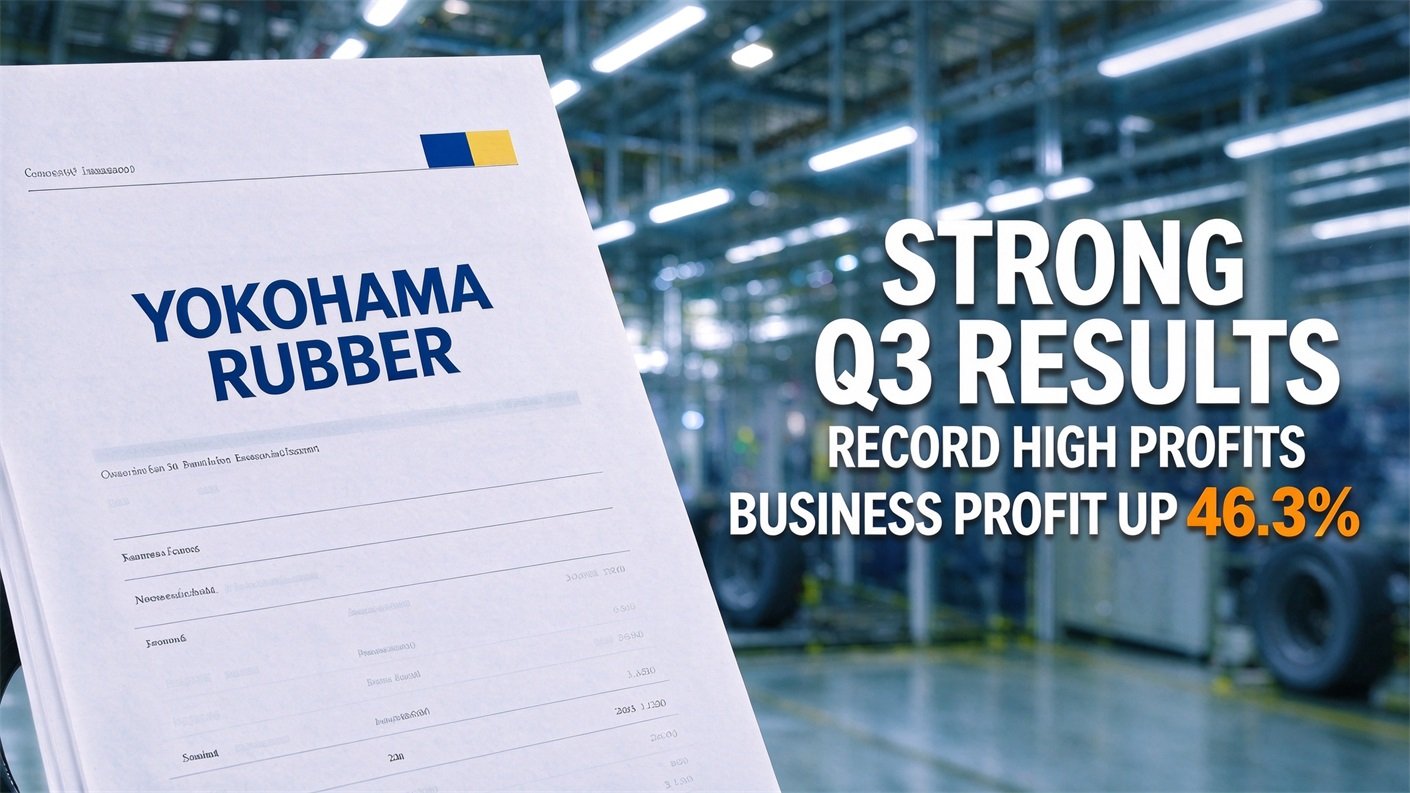
For the first nine months, group revenue stood at ¥967 billion, up 10.2% year-on-year. Business profit jumped 46.3% to ¥147.4 billion, lifting the profit margin to 15.2%. In Q3 alone, revenue reached ¥327.5 billion (+9.9% YoY), while business profit rose 33.5% to ¥51.5 billion.
Tire operations (including off-highway tires, OHT) generated revenue of ¥880 billion, rising 10.6% year-on-year with a 47.3% increase in business profit. The OHT segment stood out with a 65.2% surge in profit, acting as a core growth driver. Regional performance varied sharply: replacement tire demand remained strong in Europe while OE sales continued to decline. China and India also posted double-digit growth in replacement tire sales. Globally, the OE tire market remained under pressure, and replacement tire sales in North America rebounded in Q3. Hose, aerospace components and other diversified businesses also maintained steady growth. The company has kept its full-year guidance unchanged.
This divergence is not a short-term seasonal swing, but a fundamental shift reshaping the tire industry. Tied closely to vehicle production cycles, the OE segment is no longer a reliable profit pool amid soft new-car demand and persistent price pressure from automakers. Leading players are shifting focus from chasing new vehicle sales to tapping into the vehicle parc market. Still, the replacement tire track is not risk-free. Rising channel competition and mounting trade barriers are squeezing low-price, volume-only strategies. Future competition will center on brand premium, channel governance and high-value product portfolios.
The strong upturn in OHT is one of the most notable signals from this earnings release. Less correlated to passenger vehicle cycles, off-highway tires benefit from global spending on mining, infrastructure and agricultural machinery, delivering stronger profit elasticity. It has become a key priority for international tire giants. That said, high margins come with high barriers. Advanced manufacturing technology, lengthy customer qualification cycles and global after-sales networks are all prerequisites. The segment also faces larger swings in order volumes, freight costs and commodity prices than consumer tires. Manufacturers should avoid blind capacity expansion and assess their technical, financial and overseas service capabilities before entering.
The results also highlight the growing gap in pricing power across the sector. A large share of Yokohama’s profit growth came from product mix improvement and successful price adjustments, amplified by favourable exchange rates and raw material costs. By contrast, many tire makers remain trapped in homogenised segments, struggling to pass cost hikes downstream and seeing profits eroded by raw material and logistics expenses. The industry’s Matthew effect is accelerating. Manufacturers with global footprints, high-end product lines and diversified revenue streams hold clear advantages in navigating cyclical headwinds.
It is also worth noting that the current tailwind in Europe’s replacement tire market is fragile. Carbon border rules, environmental regulations and trade reviews keep tightening compliance costs for foreign suppliers. For Chinese tire exporters, the long-term solution lies not in grabbing market share through short-term tactics, but in proactive certification, localised channel building and brand development to mitigate policy risks. Gains from favourable raw material prices and exchange rates are temporary. Supply chain hedging, formulation optimisation and diversified sourcing will remain core long-term priorities for all rubber and tire manufacturers.
At its core, Yokohama’s strong performance represents a successful cross-cycle asset allocation strategy adopted by a global leader: using high-growth specialty tires and resilient replacement tire business to offset headwinds in the OE market. The model offers valuable reference, yet it cannot be copied easily. Tire companies need to identify differentiated paths aligned with their own resources.
DLFTECH is a professional equipment marketing & service company built by a senior R&D and marketing team in the tire & conveyor belt equipment industry. Benefiting from the rapid follow up of the international rubber industry's process re-engineering and the demand for industrial intelligence, DLFTECH, the best of the best, has rapidly developed into a new star in the international rubber machinery industry.
If any tire or conveyor belt industry customers need such as tire bead winding line, tire mold laser cleaning system, hydraulic curing press for PCR/TBR, etc., please feel free to contact info@delphygroup.com.